Venice (Italy), 1494
Luca Pacioli, Summa de arithmetica, geometria, proportioni et proportionalità (Venice: Paganinus de Paganinis, 1494), fol. 36v.
Washington DC, Dibner Library of the History of Science and Technology, QA32 .P118 1494 quarto.
(Image courtesy of the Smithsonian Libraries and Archives. Public Domain / CC0)
Overview
Printed in Venice in 1494, Summa de arithmetica, geometria, proportioni et proportionalità by Luca Pacioli stands as one of the great landmarks of early print culture. Written in the Tuscan vernacular, it is widely regarded as the first printed book on algebra and a foundational text of accounting. Yet, Pacioli did not create an entirely new mathematical tradition. Rather, he emerged from the Italian abbacho milieu, teaching and writing within the genre.
Although Pacioli rarely cited his sources, much of the Summa draws directly on Fibonacci’s work, including his revised system of finger-counting. In fact, it was largely through Pacioli that Fibonacci’s work reached a wider audience, since Fibonacci’s manuscripts remained unprinted and largely unknown until the nineteenth century.
The Images
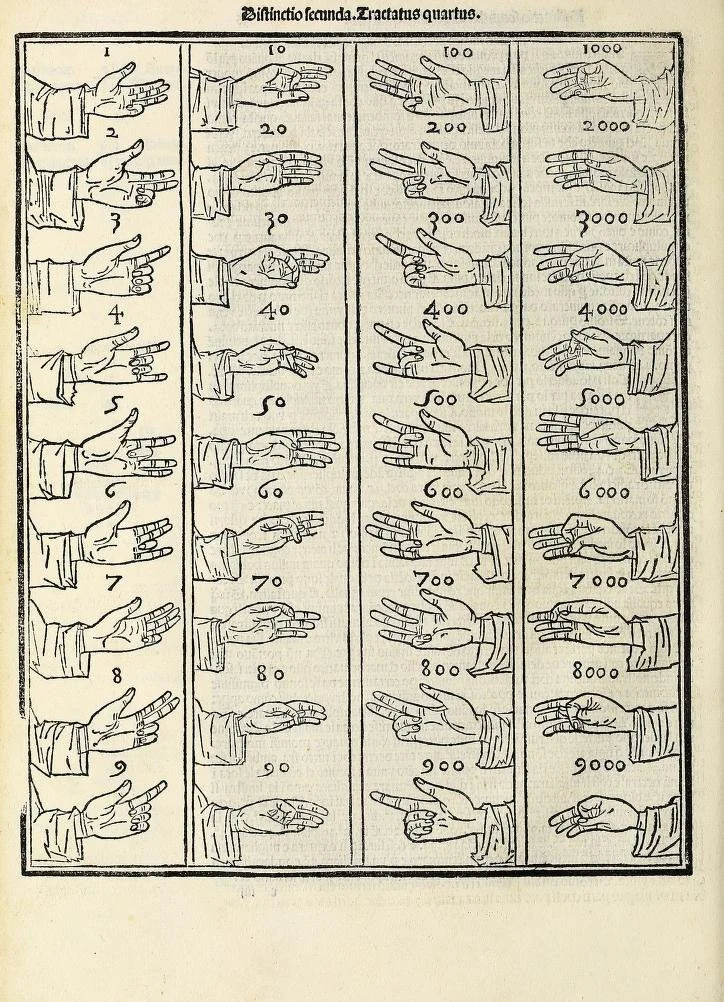
Pacioli’s treatment of finger-counting is almost entirely visual. Unlike Fibonacci, who relied primarily on textual description, Pacioli presents the system through a full-page woodcut. The diagram is organized into four vertical columns, each containing nine hand gestures labeled by Hindu-Arabic numerals, for a total of thirty-six configurations representing numbers from 1 to 9,000. The two columns on the left display gestures of the left hand (units and tens), while the two on the right show those of the right hand (hundreds and thousands). Accompanying text is minimal — just a few lines — leaving the image to carry the burden of explanation.
Unlike medieval manuscript diagrams, which varied from copy to copy, every impression of Pacioli’s woodcut was identical. This standardization gave the image an authority and stability that earlier representations lacked. As a result, it became the canonical visual reference for the finger-counting system, a status it would retain well into the modern period.
Repeatable Authority and Persistent Ambiguity
The very features that made Pacioli’s woodcut so effective also contributed to the persistence of its flaws. While Fibonacci had attempted to clarify ambiguities in the system, many of these reappear in Pacioli’s printed diagram. Gestures that should be distinct — such as those for 1 and 7 — are difficult to differentiate. Conversely, gestures that should be identical, such as those for 60 and 6,000, are shown as distinct. In total, more than half of the gestures depicted are ambiguous and easily confused.
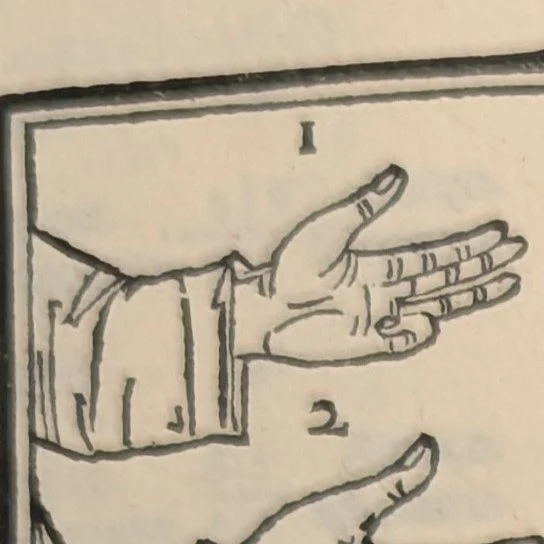
Number 1
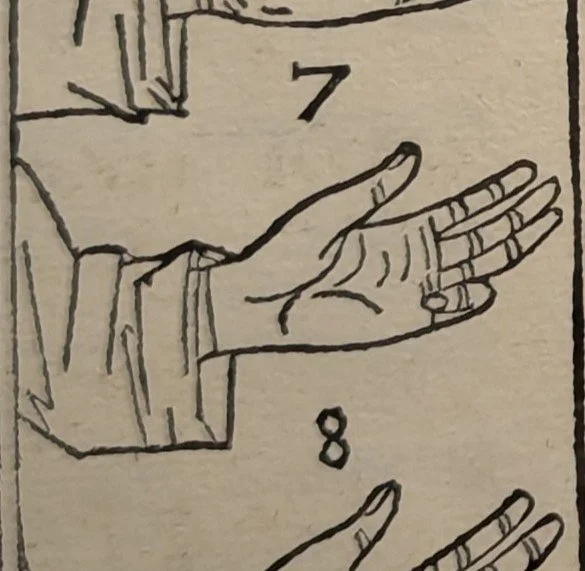
Number 7
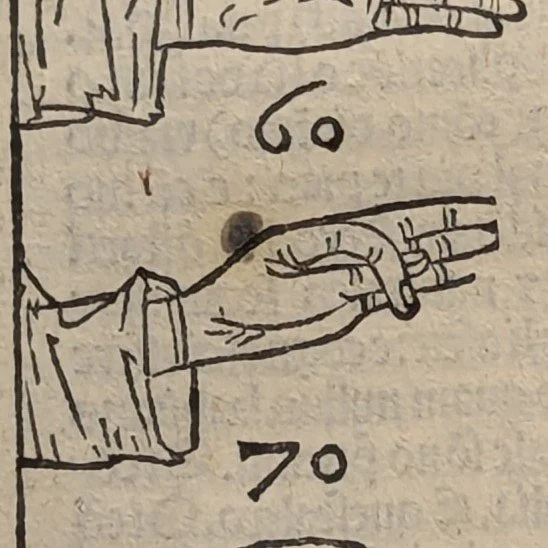
Number 60
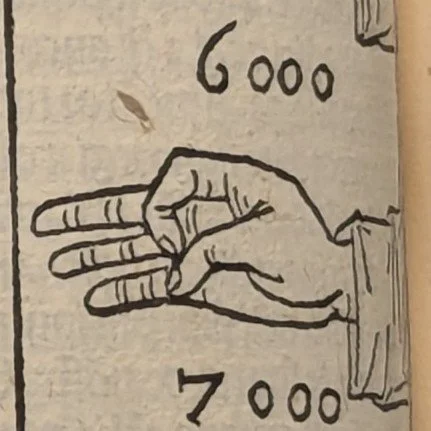
Number 6,000
(Image courtesy of the Smithsonian Libraries and Archives. Public Domain / CC0)
Later authors adopted Pacioli’s layout almost without modification, replicating the same four-column structure and even the same problematic gestures. Works such as those by Juan Andrés and Pierio Valeriano attest to the wide circulation and authority of Pacioli’s diagram, often crediting him — rather than Fibonacci or Bede — with the system itself.
That so many readers and authors reproduced the diagram without noticing its inconsistencies strongly suggests that, by this point, the manual practice of finger-counting had largely died out. People no longer recognized the gestures because they no longer performed them.
Find more information on this book and a full digitization here.