Camaldoli (Italy), c. 1395
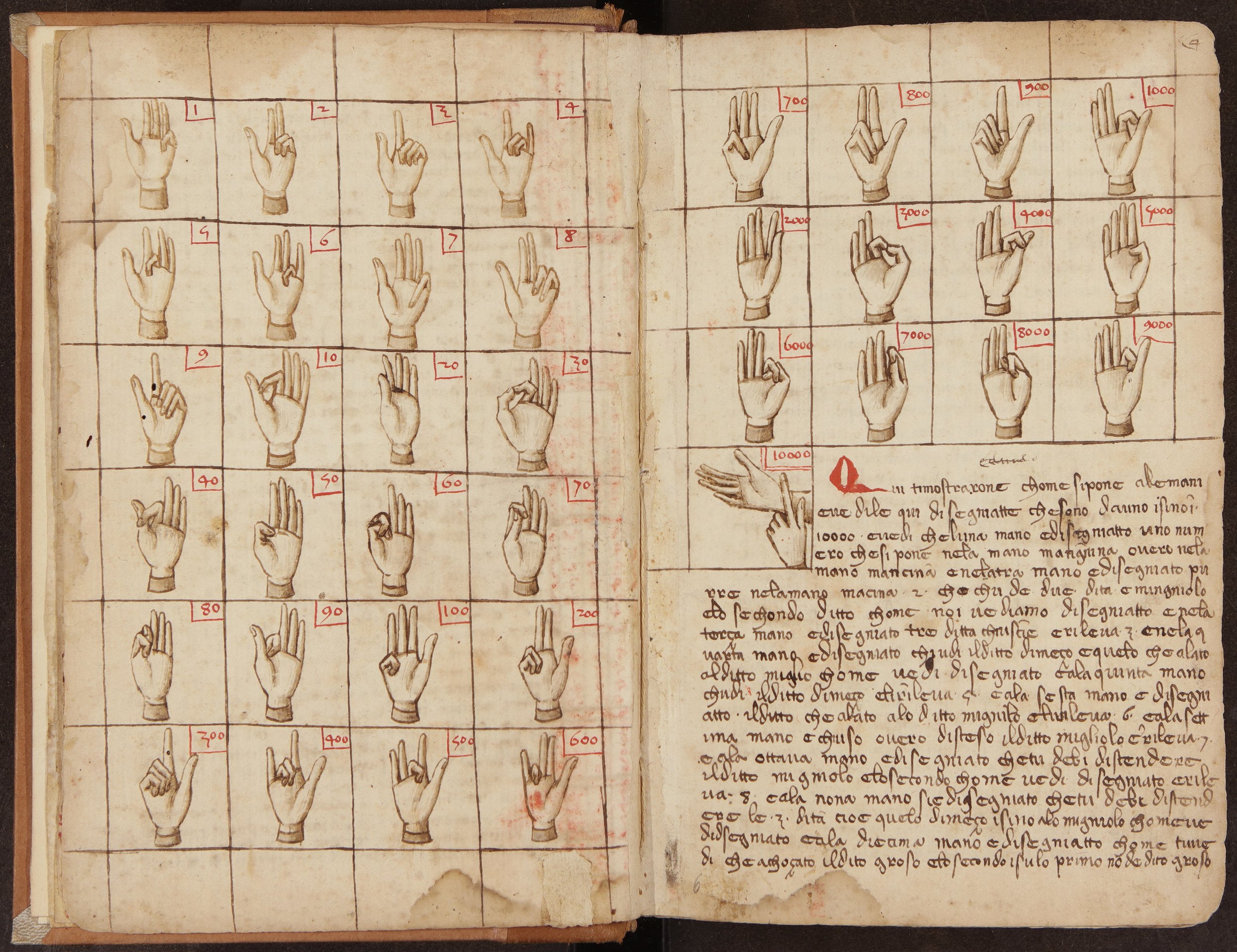
Florence, Biblioteca Nazionale Centrale, Conv. Soppr. G.VII.1137, fols. 5v-6
(© Biblioteca Nazionale Centrale di Firenze. Reproduced with permission. All rights reserved)
Overview
This late medieval manuscript, produced in northern Italy in the late fourteenth century, belongs to the rich tradition of Italian abacus books (libri d’abbaco) — practical mathematical manuals used for commercial education. It contains instruction in numeration, arithmetic operations, algebra, geometry, and problem-solving techniques. Like many such manuscripts, it combines textual explanation with diagrams and tables.
Among its most striking features is a sequence of diagrams illustrating the art of finger-counting. These images appear on folios 5v–6, at the beginning of an anonymous mathematical treatise conventionally titled Libro delle ragioni d’abbaco. They present the system of finger-counting as it was used by late medieval Italian mathematicians and merchants. This particular variant of the system can be traced back at least to 1202, when Leonardo Fibonacci described a simplified version of the ancient practice, better suited to contemporary mathematics and trade. Among the changes he introduced was a reduction in scope: instead of extending to 1,000,000, the system became limited to numbers below 10,000, avoiding the complex and impractical gestures required for higher quantities, which involved the whole body rather than just the hands.
The Images
This manuscript, now preserved in the Biblioteca Nazionale Centrale of Florence, contains a short explanation of the finger-counting system written in Italian. Immediately preceding it is a four-column grid spread across two pages, comprising thirty-seven squares. Each square contains a simple pen drawing in gray of a hand gesture, skillfully rendered with shading and details such as fingernails and creases. Each gesture is paired with a Hindu–Arabic numeral written in red. The series progresses from units through tens and hundreds to thousands, culminating in a distinctive gesture for 10,000.
A grid layout in which gestures are aligned both vertically and horizontally is fairly common in medieval and early modern representations of finger-counting. However, this particular arrangement — based on a regular square tiling framework in which each gesture is enclosed within its own compartment — has no close contemporary parallels. It does, however, recall certain earlier medieval examples which are arranged in a similar tabular layout, such as Munich, Bayerische Staatsbibliothek, Clm 14436; Vienna, Österreichische Nationalbibliothek, Cod. 1063; and Bruges, Bibliothèque Publique, Ms. 527.
Precise Gestures and a Round boundary
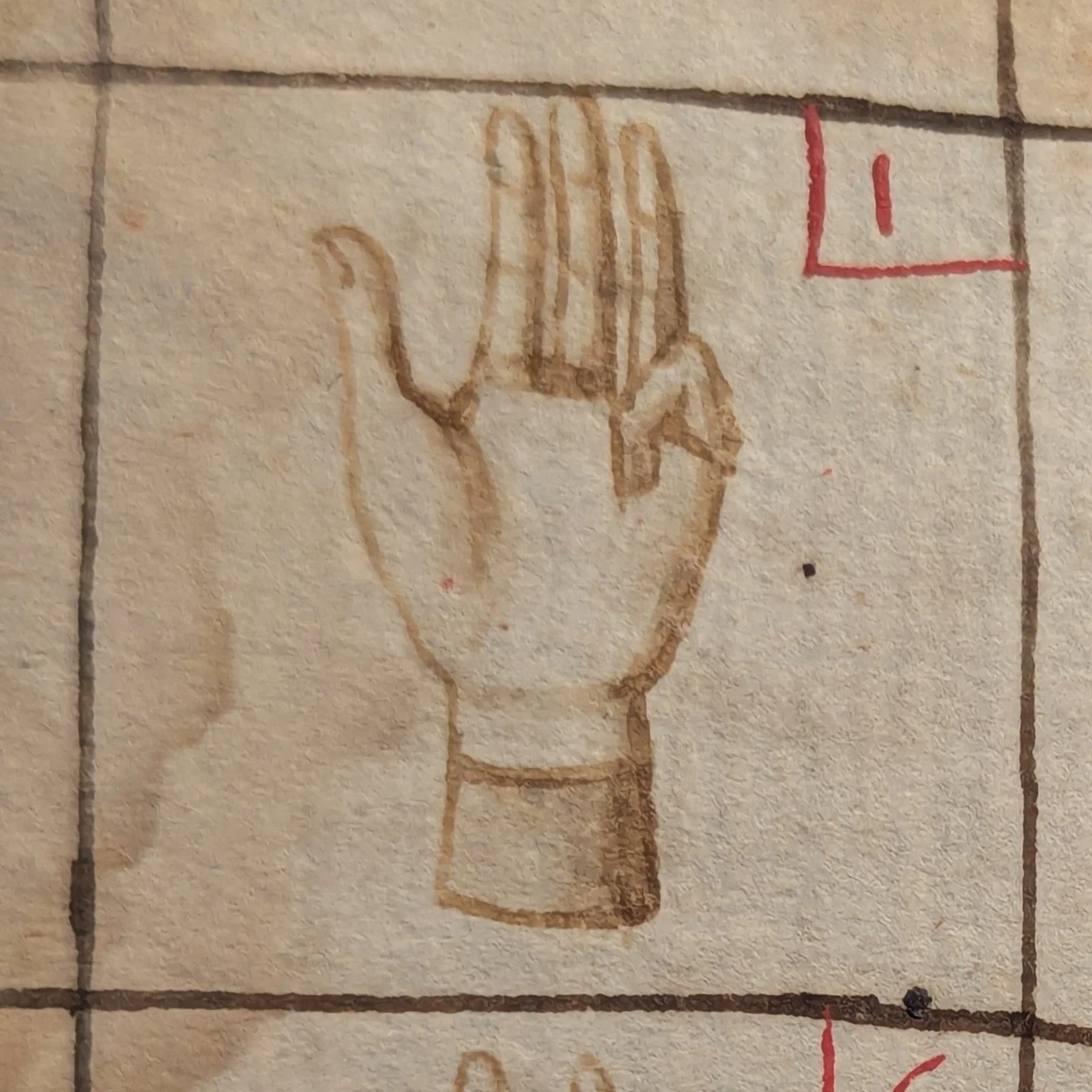
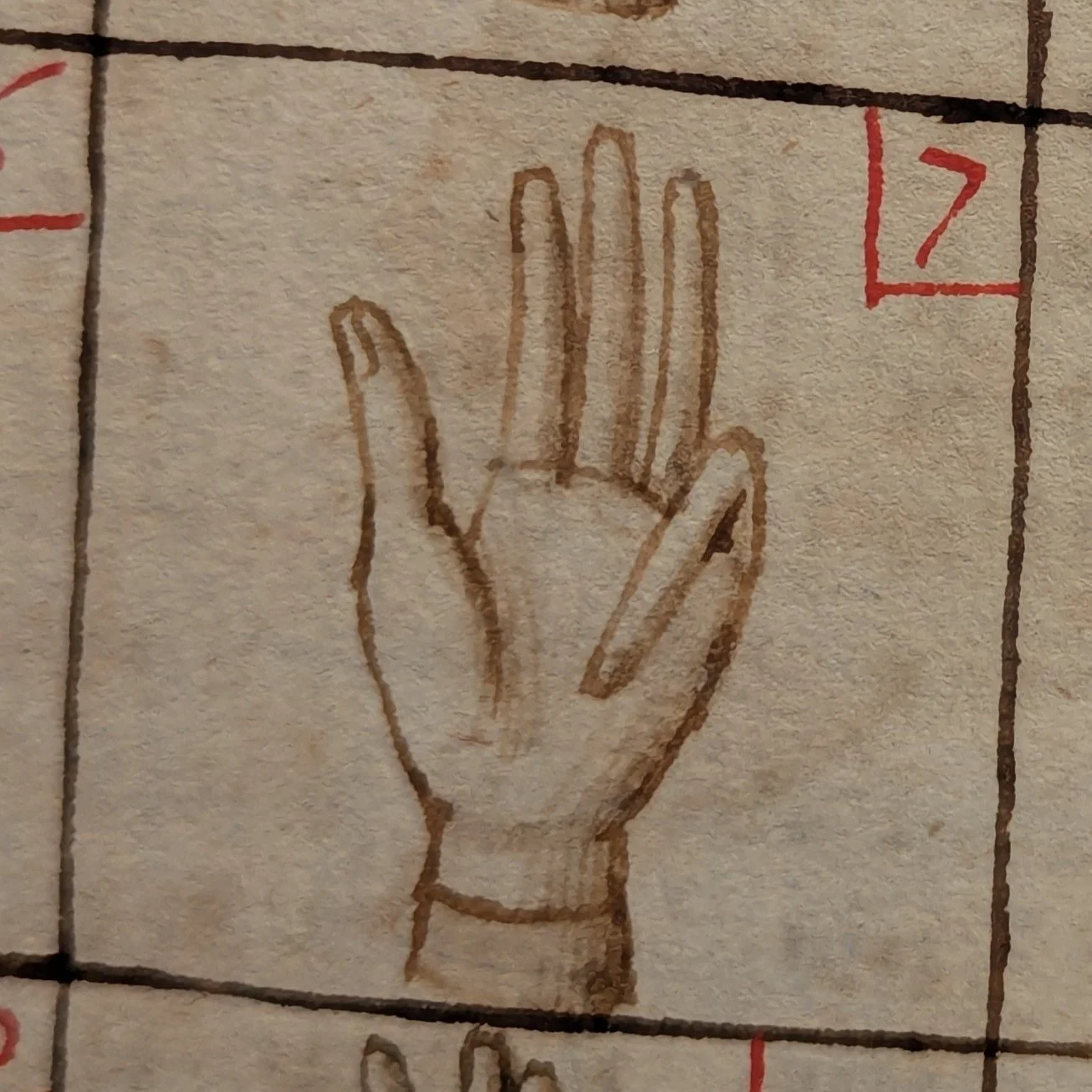
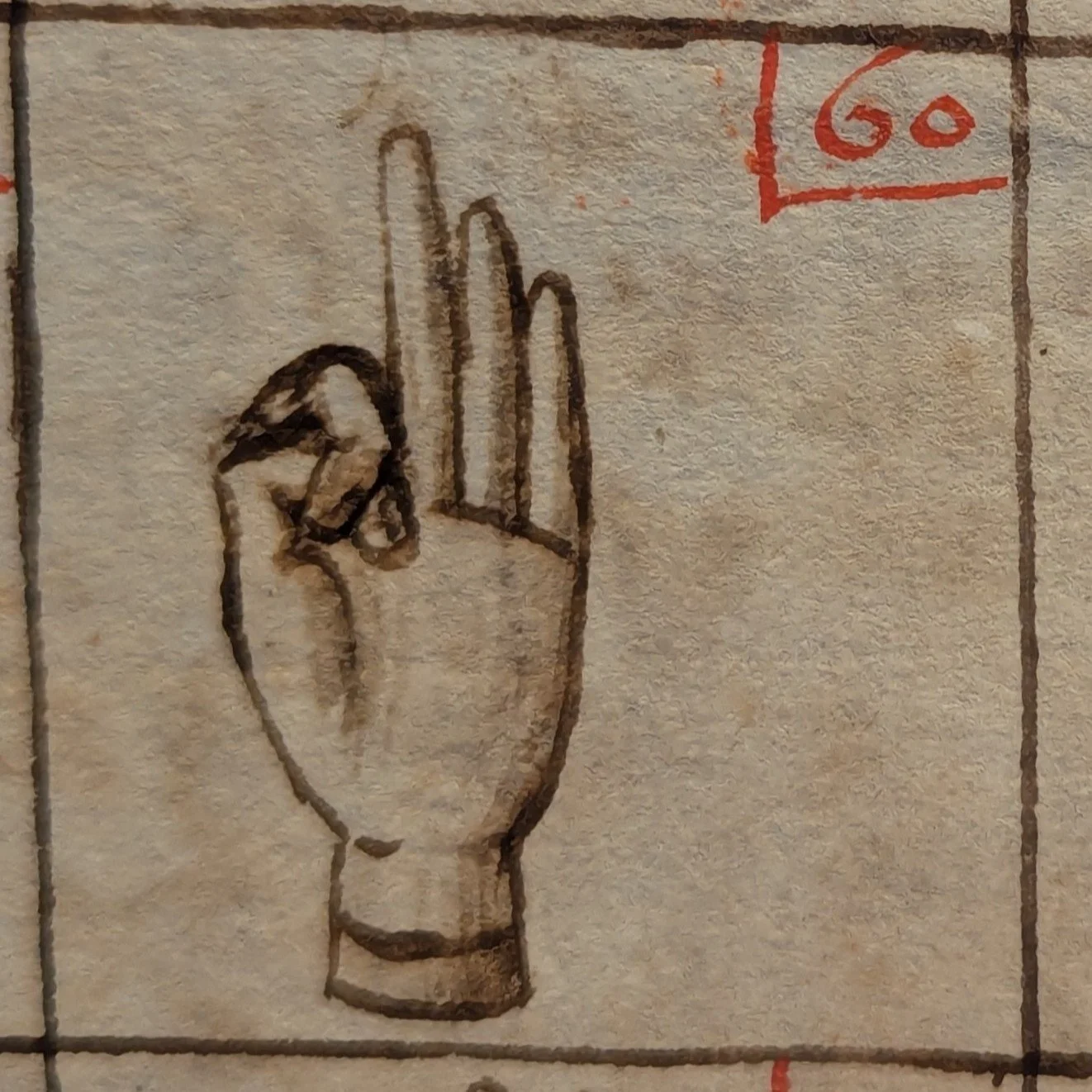
The gestures are depicted with remarkable precision. Unlike many medieval and early modern representations of the finger-counting system, this diagram clearly distinguishes between gestures such as 1 and 7, which are often confused because of their similarity. Likewise, more complex configurations — such as that for 60, which involves bending the thumb and encircling it with the index finger — are carefully drawn in a way that respects both the anatomy of the hand and the sometimes challenging written instructions.
Number 1
Number 7
Number 60
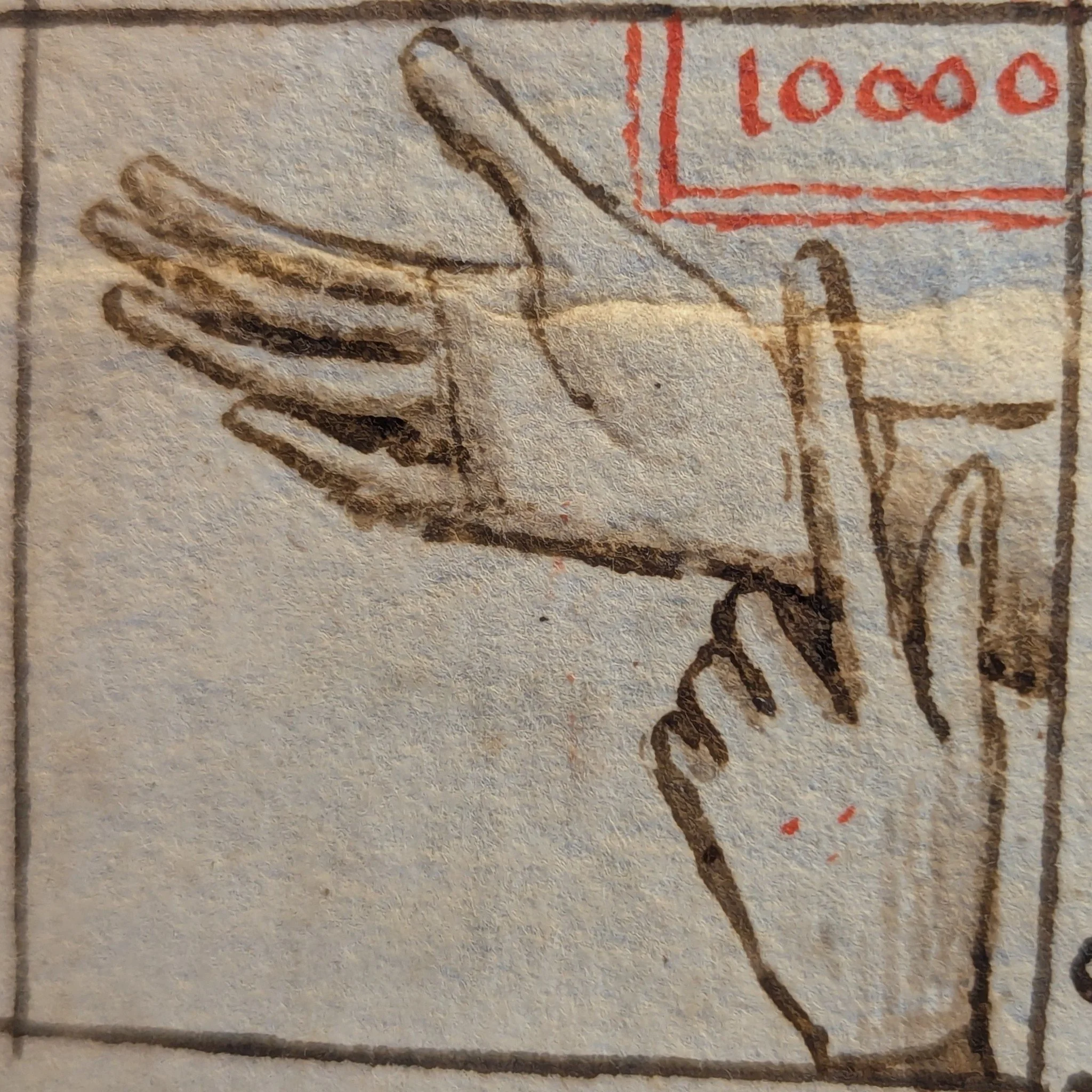
Number 10,000
(© Biblioteca Nazionale Centrale di Firenze. Reproduced with permission. All rights reserved)
The most striking feature of the sequence, however, is the inclusion of a two-handed gesture for 10,000, in which the left index finger is placed across the wrist of the upturned right hand. This gesture does not appear to be attested elsewhere. It was likely introduced as a corrective or extension to Fibonacci’s version of the system—adopted in most late medieval Italian abacus schools—which included only numbers from 1 to 9,999. The addition of 10,000 provides a sense of formal closure by establishing a round upper limit. Like the gesture for 1,000,000 in the earlier tradition, it employs both hands to mark a numerical boundary. There is little evidence that this innovation achieved wider circulation, as it does not appear in later manuscripts or printed books. Nevertheless, its presence here offers a rare glimpse into the experimental and innovative character of computational practice in late medieval Italy.