T e x t s
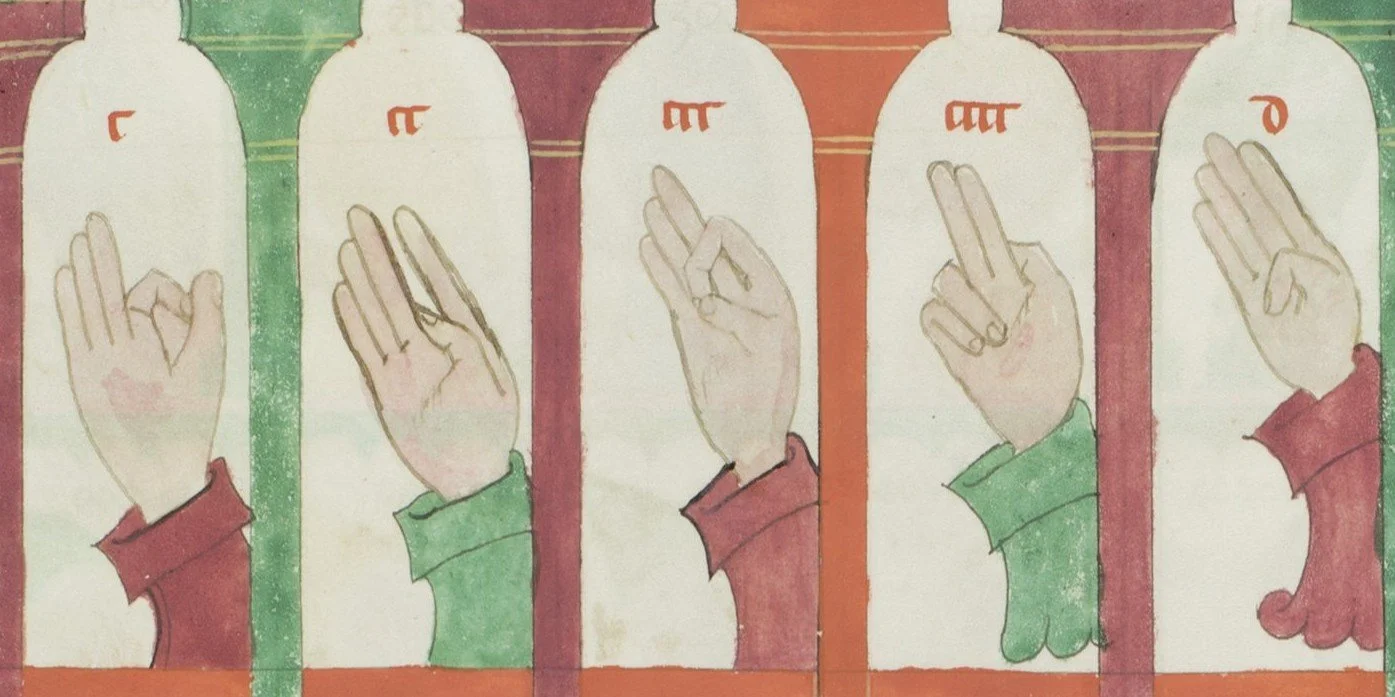
Even though finger-counting was commonly known throughout the Mediterranean from at least the first century AD, the earliest known full description of the complete set of gestures was written in the early Middle Ages in the British Isles.
Driven by a range of concerns — from calendrical reckoning to mercantile arithmetic, and even cryptography or magic — many medieval and early modern authors described the finger-counting system. In doing so, they sometimes clarified or simplified particular gestures, and sometimes altered the system more fundamentally.
Here you will find a selection of these texts, which are both descriptive and prescriptive, accompanied by brief commentary and an English translation.
-
Written in 725 AD by the British monk and scholar Bede the Venerable (c. 672–735), the treatise De Temporum Ratione (On the Reckoning of Time) is a foundational masterpiece of medieval science. Primarily concerned with the complex mathematics and astronomy required to determine the date of Easter, this important work also helped popularize the Anno Domini (AD) dating system, thereby shaping the way much of the world has structured and recorded historical time for more than a millennium.
The first chapter of the treatise, titled De computo vel loquela digitorum (“On the Computation or Language of the Fingers”), introduces the ancient system of finger-counting and describes a specific hand gesture for every number from 1 to 1,000,000. At the end of this chapter, Bede also explains another use of the finger-counting system: cryptography.
Bede’s text is one of the earliest — and by far the most influential — descriptions of the ancient finger-counting system.
-
Written in 1202 by the Italian mathematician Leonardo Pisano, also known as Fibonacci (c. 1170–1240), the Liber Abaci (Book of Calculation) is one of the most consequential mathematical works of the medieval West. Celebrated above all for introducing the Hindu-Arabic numeral system to a European audience, as well as the famous Fibonacci sequence, this treatise also played a crucial role in the transmission of a far older numerical practice: finger-counting.
The opening chapter of the Liber Abaci, dedicated to numeration, presents the Hindu-Arabic numerals and, immediately after, the ancient system of finger-counting. Fibonacci’s version of the finger-counting system covers numbers from 1 to 9,999 and differs from Bede’s in several respects, including a reversal in the positions of the hundreds and thousands. Fibonacci's version is better suited to the practical demands of mercantile mathematics and sits closer to the structural logic of Hindu-Arabic numerals. It went on to become the standard reference for early modern finger counting.
Contrary to a common misconception, Hindu-Arabic numerals did not displace finger-counting. For Fibonacci, as for many later medieval mathematicians, the new notation and the old gestures remained closely connected parts of the same computational culture.
-
Written in 1494 by the Italian mathematician and Franciscan friar Luca Pacioli (c. 1447–1517), the Summa de arithmetica, geometria, proportioni et proportionalità is a landmark of early print culture. Written in Italian, it is celebrated as the first printed book on algebra and the first to describe the double-entry bookkeeping system, making it a foundational text in the history of accounting.
The Summa de arithmetica includes a treatment of the ancient finger-counting system, closely following Fibonacci’s version. However, its approach differs strikingly from Fibonacci, who relied primarily on written description and only secondarily on image. Here, finger-counting is presented visually through a large, full-page woodcut illustration depicting hand positions, accompanied by only a brief and sparse text. The image does most of the work, and the words merely supplement it.
Pacioli's woodcut became the main visual reference for the ancient tradition of finger-counting even to this day.