Lorsch (Germany), 800–850
Vatican City, Biblioteca Apostolica Vaticana, Pal. lat. 1449, fol. 118v
(© Biblioteca Apostolica Vaticana. Reproduced with permission. All rights reserved)
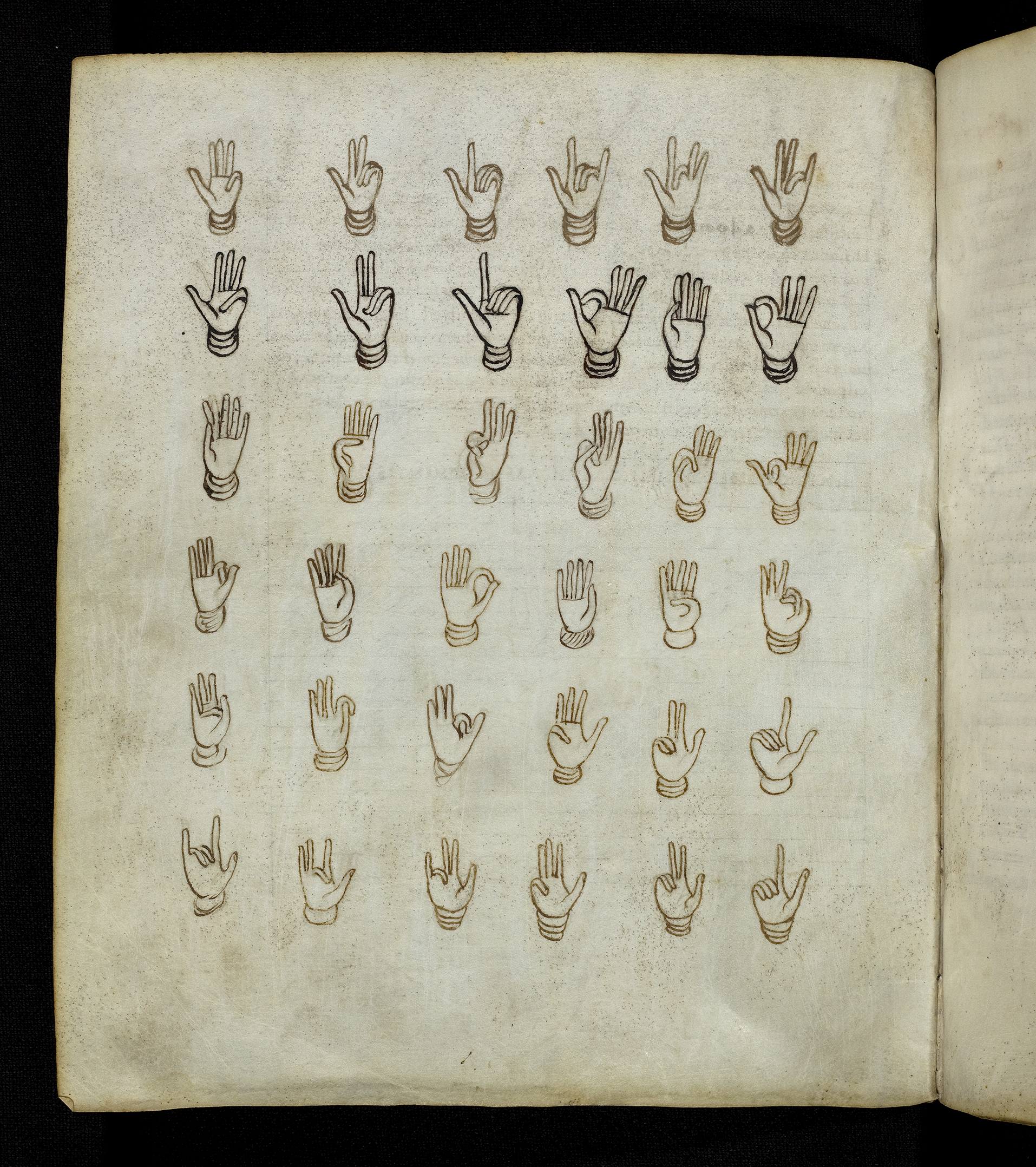
Overview
This beautiful manuscript, produced at the Abbey of Lorsch in the first half of the ninth century, served as a kind of computistical "Swiss Army knife" of the early Middle Ages. It encompasses astrology, timekeeping, medicine, historiography, and calendrical science. Drawing heavily on the works of the Northumbrian scholar-monk Bede the Venerable, it included some of his most influential scientific treatises, among them De temporum ratione (On the Reckoning of Time).
The opening chapter of De temporum ratione explains in careful detail how to count to one million using hand gestures. Beyond this textual description, however, the manuscript also preserves a visual diagram on folio 118v. It is the earliest known illustration of the finger-counting system.
The Images
In this manuscript from the Biblioteca Apostolica Vaticana in the Vatican City, an entire page is dedicated to illustrating Bede’s description of the finger-counting system. The diagram depicts all thirty-six gestures for numbers from 1 to 9,000, arranged in a 6 × 6 grid: the top three rows show gestures performed with the left hand, while the bottom three rows show those performed with the right.
The following page is blank, suggesting it was intended to house the remaining gestures — those for the tens and hundreds of thousands, conventionally represented through half-length human figures enclosed within roundels — but was never completed.
This layout, featuring a hand grid followed by busts within roundels, was fairly common in medieval finger-counting diagrams. Like this manuscript, MS 27 from the Biblioteca Antoniana in Padua is similarly unfinished, preserving only the 6 × 6 grid and leaving subsequent pages empty. Examples of the complete structure survive in MS D III 19 from the Biblioteca Nazionale Universitaria di Torino, MS 189 from the Biblioteca Statale del Monumento Nazionale di Montecassino, and BPL 191 BD from the Universiteitsbibliotheek in Leiden.
Careful Corrections and Telling Lapses
Despite the elegance of their minimalist execution, the drawings are not fully accurate illustrations of Bede's finger-numeration system. Several ambiguities appear throughout the sequence, alongside a few anatomical errors.
While there is an apparent effort to distinguish between commonly confused gestures — such as those for 1 and 7, or 2 and 8 — other confusions persist, as between 1,000 and 7,000, or 2,000 and 8,000.
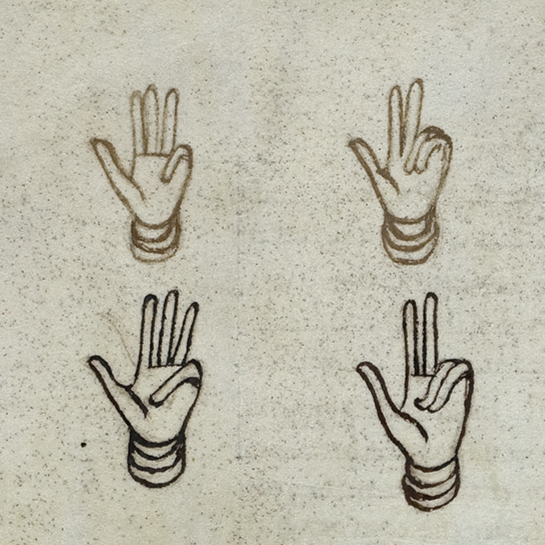
Numbers 1,2,7, and 8
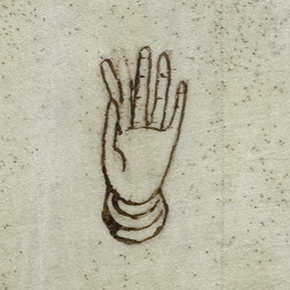
Number 40
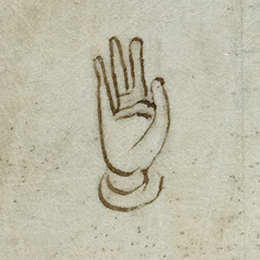
Number 700
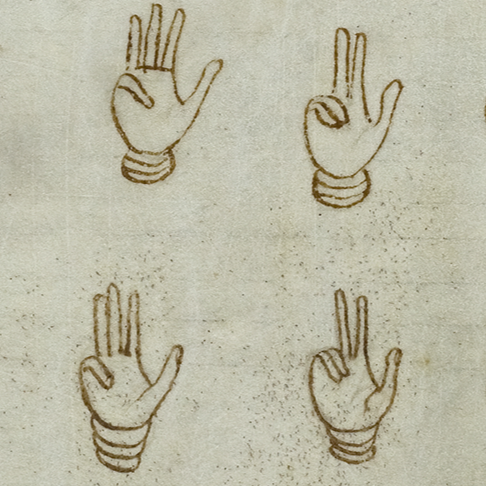
Numbers 1000,2000,7000,8000
(© Biblioteca Apostolica Vaticana. Reproduced with permission. All rights reserved)
It is also clear that greater care toward precision was taken with the gestures for smaller numbers, shown in the upper rows, than with those for larger ones. For instance, a finger was erased and repositioned in the depiction of 40, yet the hand for 700 was left with only four fingers, uncorrected.
This disparity between the top and bottom rows likely reflects practical familiarity: an early medieval scribe would have had many occasions to use the left-hand gestures for numbers below 10,000, whereas there would have been less need for higher configurations; therefore, these higher numbers would have remained less practiced.
Find more information on this manuscript and a full digitization here.