Rhineland (germany), 1100–1150
Leiden, Universiteitsbibliotheek Leiden, BPL 191 BD, fols. 4r-5v
(Image courtesy of the Leiden University Libraries. Public Domain)
-
![]()
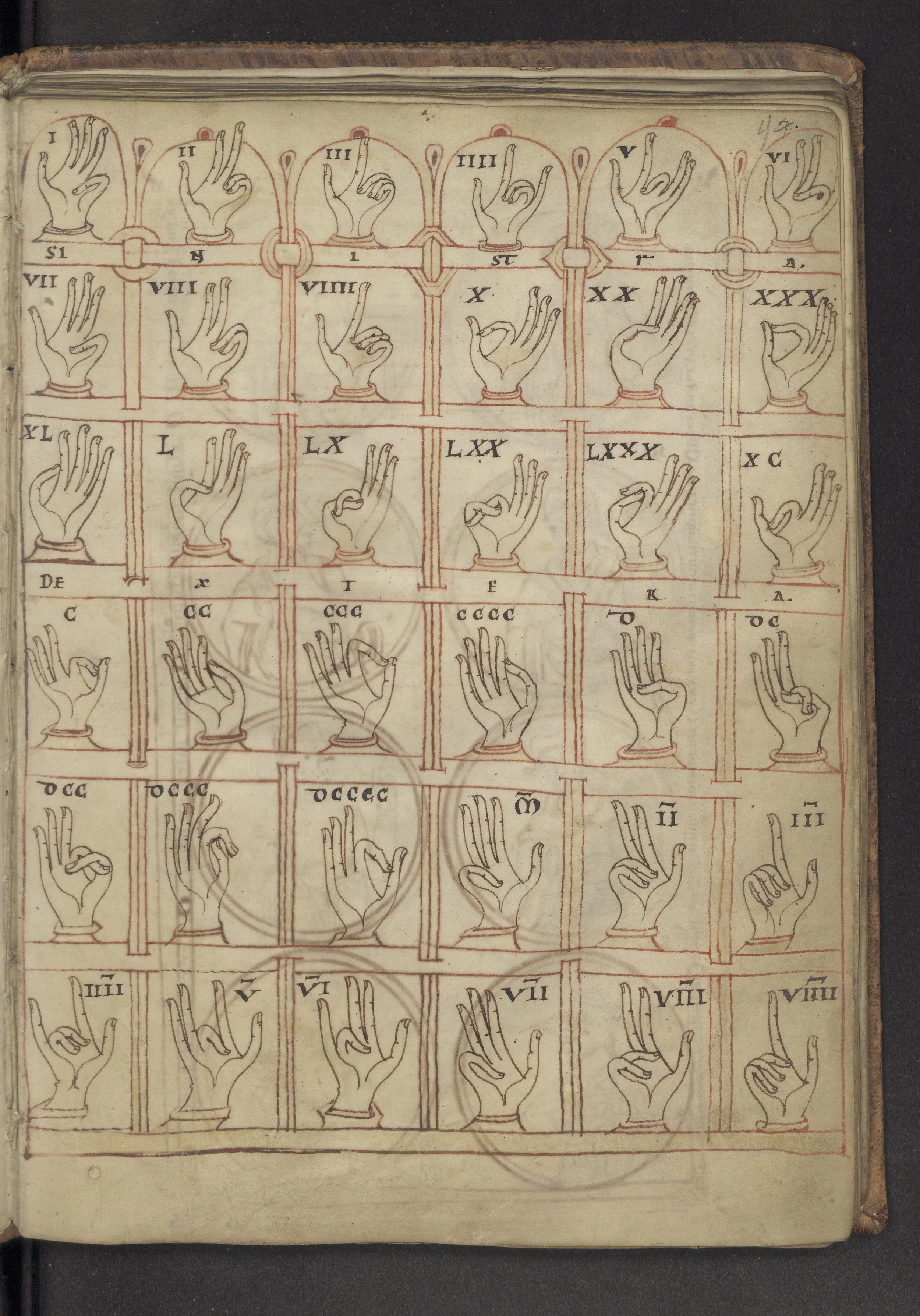
Fol. 4r
-
![]()
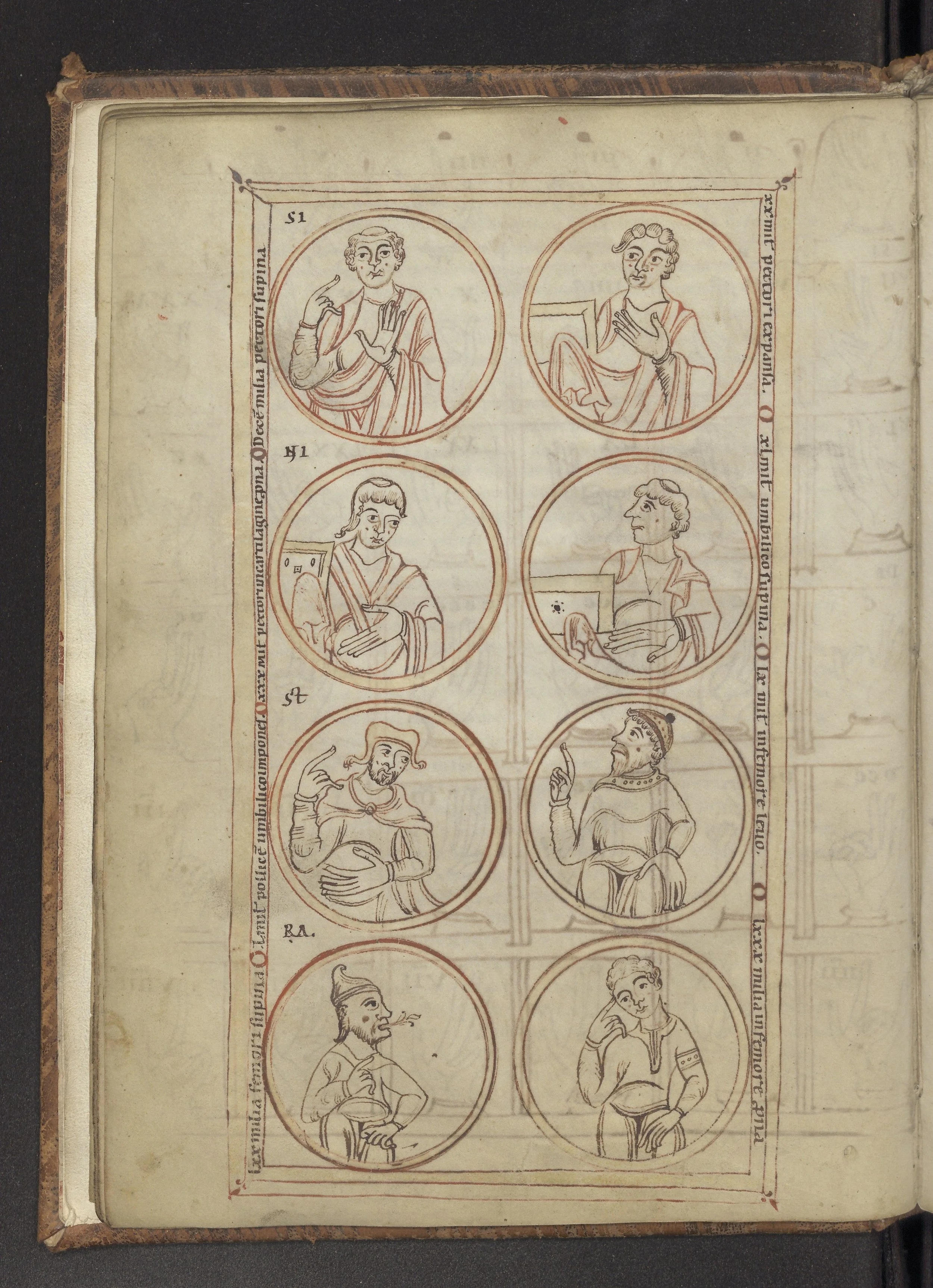
Fol. 4v
-
![]()
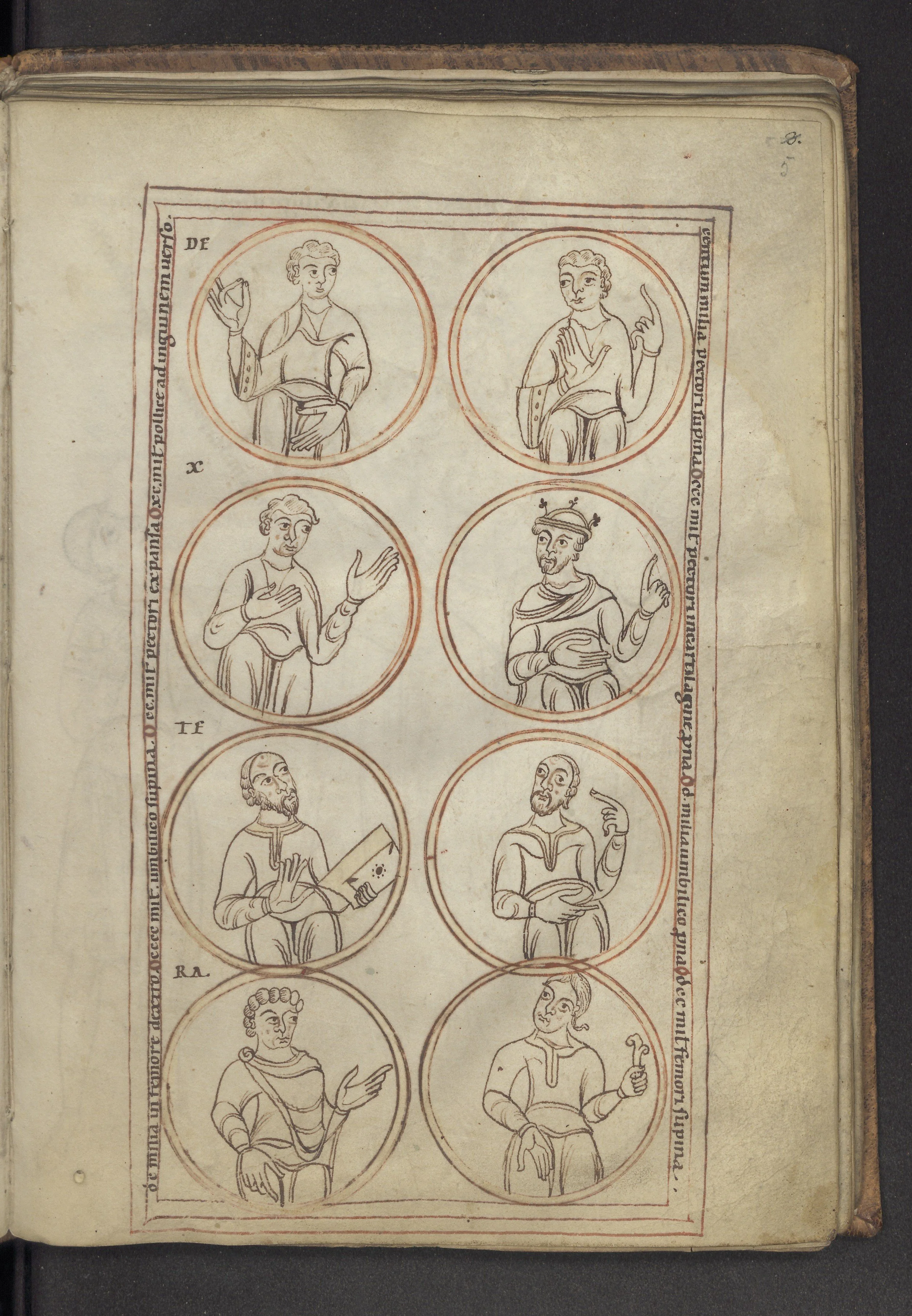
Fol. 5r
-
![]()
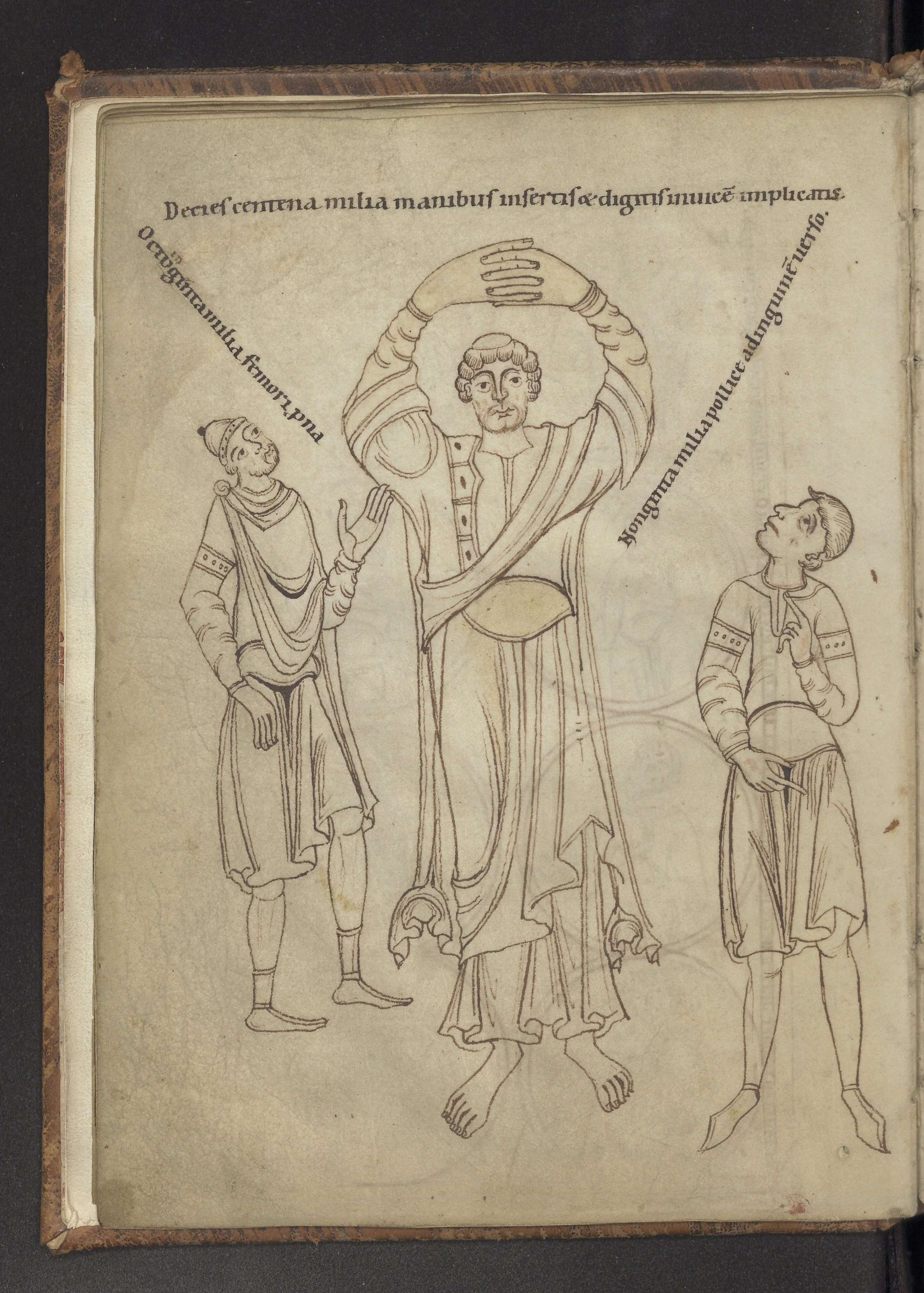
Fol. 5v
Overview
Produced in the Rhineland during the first half of the twelfth century, this manuscript preserves one of the most influential computistical works of the Middle Ages: Rabanus Maurus’s treatise De computo, written around the year 820. In its sixth chapter, Rabanus describes the ancient art of finger-counting in terms similar to those of the Venerable Bede, specifying which hand gesture corresponds to each number from 1 to 1,000,000.
A unique feature of this particular manuscript is the inclusion of an excerpt from Jerome’s letter Against Jovinian, immediately following the sixth chapter of Rabanus’s De computo. In that letter, Jerome famously used the finger-counting system to interpret the numerical symbolism contained in a parable from the Gospel. In this manuscript, the scribe adds his own comments to Jerome’s text, emphasizing that even the most sacred expositors of Scripture embraced the “shapes of numbers” as much as the “shapes of letters.”
The Images
In this manuscript from the Universiteitsbibliotheek in Leiden, the texts of Rabanus and Jerome are followed by a highly structured visual program organized across several folios: thirty-six drawings of hands for numbers below 10,000, arranged in a 6 × 6 grid and each labeled by a Roman numeral (fol. 4r); sixteen half-length human figures enclosed within roundels for the tens and hundreds of thousands (fols. 4v–5r); and three full-length figures representing 800,000, 900,000, and 1,000,000 (fol. 5v). Some of the figures wear distinctive headgear, including a crown (300,000) and a Phrygian cap (70,000), while others are monks or clerics, denoted by a clearly delineated tonsure.
The layout followed by this manuscript — featuring three main sections: hands in a 6 × 6 grid, busts within roundels, and full-length bodies — contains every single gesture mentioned by Bede and Rabanus Maurus with no omissions. This layout was fairly common in the central Middle Ages, particularly in the Italian peninsula. Notable parallels include MS 27 from the Biblioteca Antoniana in Padua, MS D III 19 from the Biblioteca Nazionale Universitaria di Torino, MS 189 from the Biblioteca Statale del Monumento Nazionale di Montecassino, and Pal. lat. 1449 from Biblioteca Apostolica Vaticana.
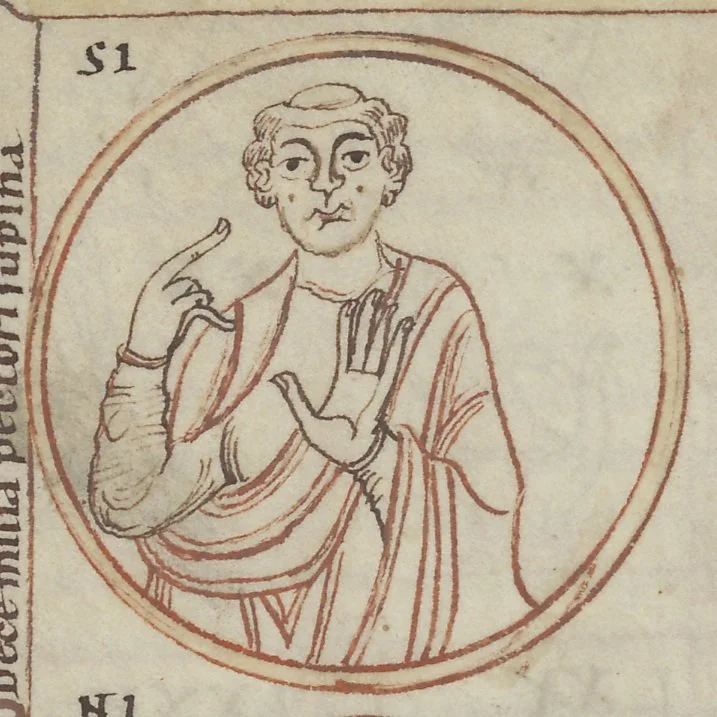
Number 10,000
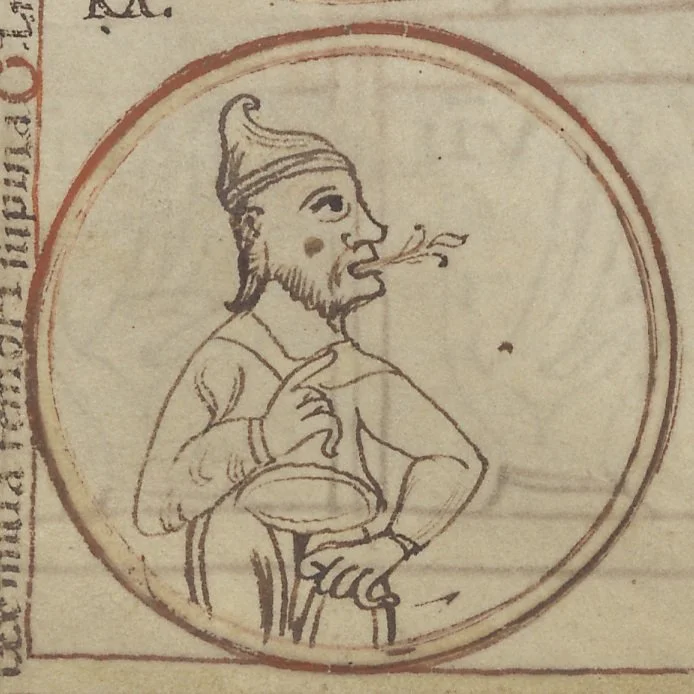
Number 70,000
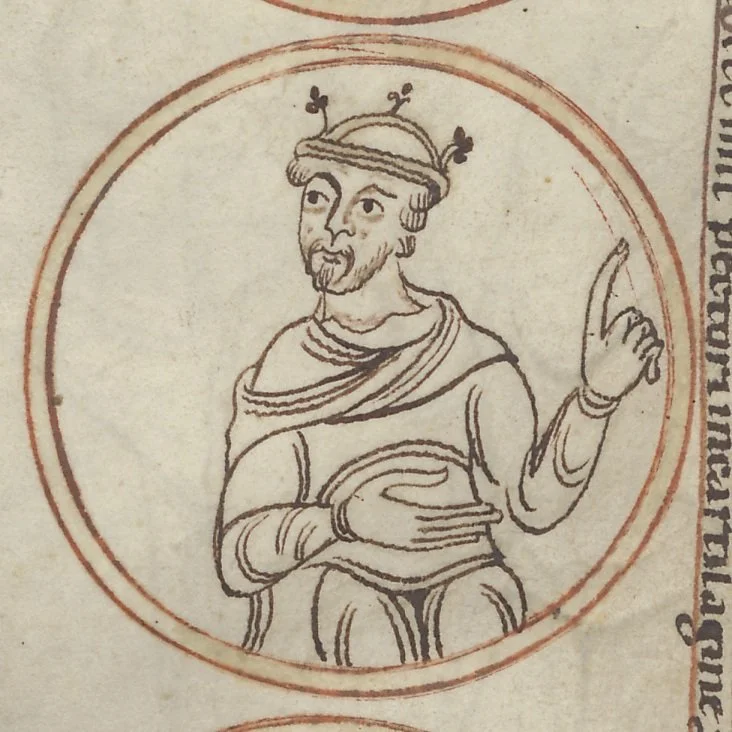
Number 300,000
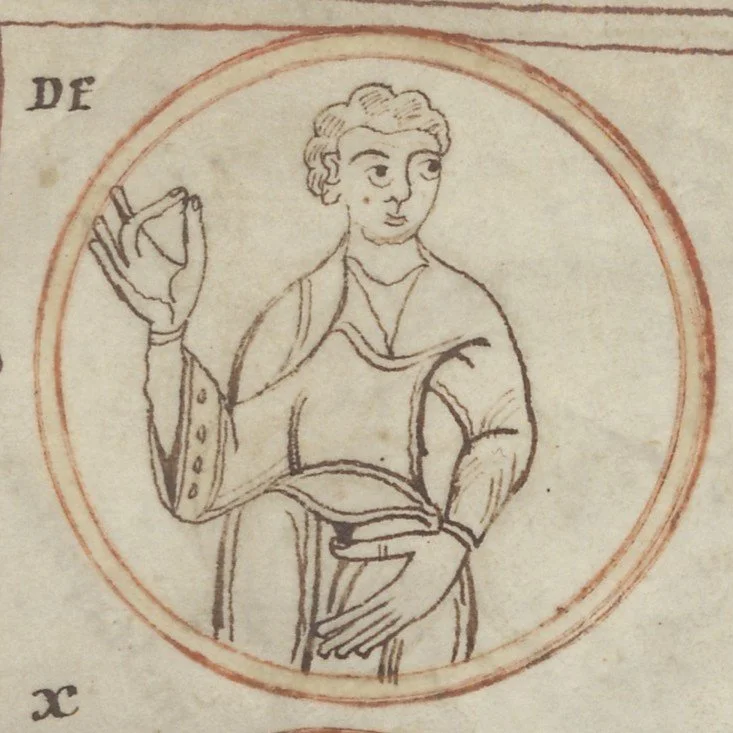
Number 90,000
(Image courtesy of the Leiden University Libraries. Public Domain)
Mnemonic Cues and a Clever Layout
Like other manuscripts of this tradition, these diagrams employ a sophisticated set of rhetorical techniques. Many of the figures are shown holding objects or pointing to specific parts of the body, triggering memory through wordplay. For example, the figure performing the gesture for 90,000 (which involves touching the groin area) uses the other hand to touch the middle finger, known as the impudicus—the "indecent" finger.
The gestures for higher numbers, which require more complex arm movements, are labeled with condensed versions of Rabanus’s descriptions. For example, 10,000 is simply labeled “decem milia pectori supina” (ten thousand, upturned on the chest), rather than the full description provided in the text: “Moreover, when you say ten thousand, you shall place the left hand upturned in the middle of the chest, with only the fingers raised toward the neck.” These labels act as shorthands that facilitate rapid recall.
The number-gestures are distributed with intentional logic. Gestures are explicitly labeled sinistra (left) and dextera (right), with the page layout split so that left-hand gestures for tens of thousands dominate the left side of the open book, while right-hand gestures for hundreds of thousands dominate the right. Furthermore, the 6 × 6 grid for smaller numbers is not merely decorative. By organizing the gestures this way, the layout exposes the “sub-base 6” structure of the system, revealing that the gestures for 7, 8, and 9 are essentially physical variations of 1, 2, and 3.
Find more information on this manuscript and a full digitization here.